
Introduction
Search Engine Optimization (SEO) has always evolved alongside technology. From keyword stuffing in the early days of search engines to today’s focus on user experience and high-quality content, SEO has become more sophisticated than ever. Now, Artificial Intelligence (AI) is driving the next major transformation.
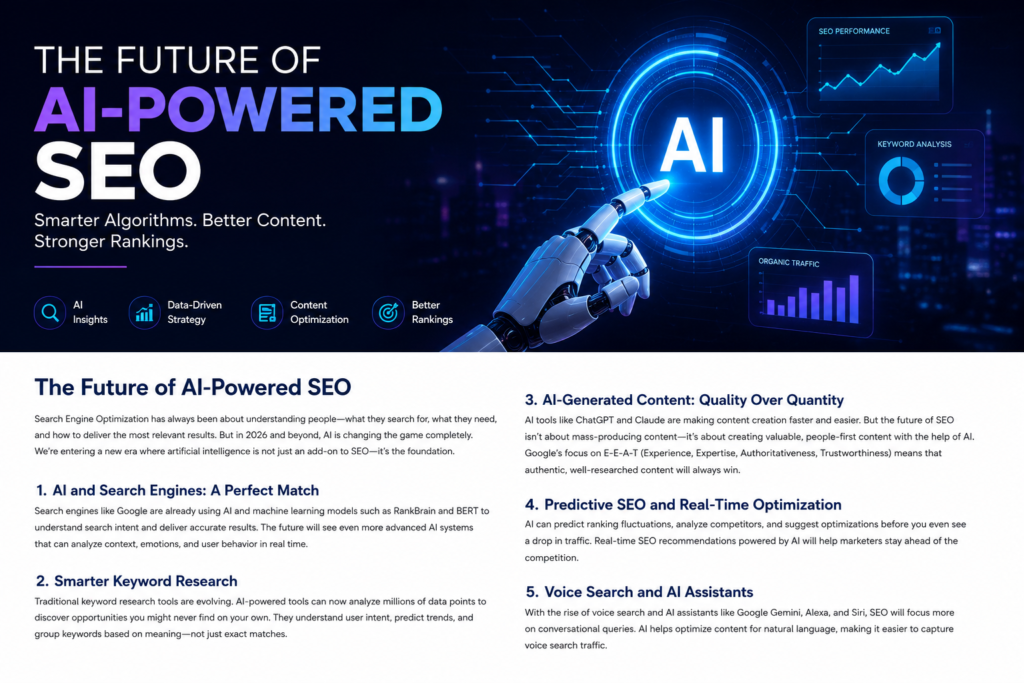
AI-powered SEO is changing how businesses research keywords, create content, optimize websites, and understand user behavior. Search engines like Google use AI to interpret search intent, deliver more relevant results, and reward websites that provide genuine value to users. As AI continues to advance, marketers who embrace these technologies will have a significant competitive advantage.
In this article, we’ll explore how AI is reshaping SEO, the benefits it offers, the challenges businesses should be aware of, and the strategies you can implement to stay ahead in the evolving digital landscape.
What Is AI-Powered SEO?
AI-powered SEO is the use of artificial intelligence and machine learning technologies to improve a website’s visibility in search engine results. Instead of relying solely on manual analysis and traditional optimization techniques, AI tools automate repetitive tasks, uncover valuable insights, and provide data-driven recommendations.
Modern AI SEO tools can:
- Perform advanced keyword research
- Analyze competitors
- Generate optimized content ideas
- Improve on-page SEO
- Detect technical SEO issues
- Predict ranking opportunities
- Understand user search intent
Rather than replacing SEO professionals, AI acts as an intelligent assistant that helps marketers make better decisions faster.
Why AI Matters for SEO
Search engines have become increasingly intelligent. Google’s algorithms now prioritize understanding the meaning behind a user’s search rather than matching exact keywords.
This means SEO is no longer about repeating keywords multiple times. Instead, successful optimization focuses on:
- User intent
- Content quality
- Expertise and trustworthiness
- Website experience
- Relevance
- Helpful information
AI enables marketers to optimize content according to these modern ranking factors while saving valuable time.
Smarter Keyword Research
Traditional keyword research focused mainly on search volume and competition. AI-powered tools go much further.
Modern AI can:
- Discover long-tail keywords
- Identify hidden search opportunities
- Group keywords by search intent
- Analyze seasonal trends
- Predict emerging topics
- Recommend semantic keywords
Instead of targeting just one keyword, businesses can build comprehensive content around entire topics, improving their authority and increasing their chances of ranking for multiple related searches.
This approach aligns perfectly with how modern search engines understand context.
AI-Generated Content with Human Expertise
AI writing tools have made content creation faster than ever. They can generate outlines, suggest headings, improve readability, and help overcome writer’s block.
However, the future of SEO isn’t about publishing large volumes of AI-generated articles.
Search engines increasingly reward content that demonstrates:
- Real expertise
- Original insights
- Practical experience
- Accurate information
- Trustworthiness
The best strategy combines AI efficiency with human creativity. Writers should use AI to assist with research and drafting while adding their own expertise, examples, opinions, and unique perspectives.
Human-edited AI content consistently delivers better long-term SEO performance than fully automated content.
Search Intent Is More Important Than Ever
One of AI’s greatest strengths is understanding search intent.
When someone searches for “best laptop for students,” they aren’t looking for the definition of a laptop. They want recommendations, comparisons, prices, and buying advice.
AI helps marketers understand whether users are searching to:
- Learn information
- Buy products
- Compare services
- Solve problems
- Find local businesses
Creating content that directly satisfies user intent improves rankings, increases engagement, and reduces bounce rates.
AI Improves Technical SEO
Technical SEO can be complex, but AI simplifies many optimization tasks.
AI-powered SEO platforms can automatically identify:
- Broken links
- Crawl errors
- Slow-loading pages
- Missing meta descriptions
- Duplicate content
- Mobile usability issues
- Schema markup opportunities
Instead of manually auditing hundreds of pages, AI can analyze an entire website within minutes and prioritize the most critical improvements.
This allows businesses to maintain healthier websites while improving overall search performance.
Personalized Search Experiences
AI enables search engines to personalize results based on user behavior, location, preferences, and previous searches.
Because of this, businesses should create content for specific audiences rather than trying to appeal to everyone.
Examples include:
- Local SEO pages
- Industry-specific content
- Personalized landing pages
- Customer-focused FAQs
- Location-based service pages
Personalization helps increase relevance, leading to higher engagement and improved rankings.
Voice Search and Conversational SEO
The popularity of voice assistants has changed how people search online.
Instead of typing:
“best SEO tools”
Users may ask:
“What are the best SEO tools for small businesses in 2026?”
AI understands conversational language remarkably well.
To optimize for voice search, businesses should:
- Write naturally
- Answer common questions
- Use FAQ sections
- Target long-tail keywords
- Optimize for featured snippets
Conversational content is becoming increasingly valuable as voice search continues to grow.
Predictive SEO
One exciting advancement is predictive SEO.
AI can analyze massive amounts of data to predict:
- Future keyword trends
- Seasonal demand
- Ranking fluctuations
- Competitor movements
- Content opportunities
Instead of reacting after rankings decline, marketers can proactively optimize their websites before competitors.
Predictive analytics allows businesses to stay ahead rather than constantly catching up.
Better Content Optimization
AI-powered optimization tools evaluate content beyond keyword density.
They analyze:
- Readability
- Content depth
- Internal linking
- Semantic relevance
- Heading structure
- User engagement signals
- Top-ranking competitors
These insights help marketers create content that satisfies both readers and search engines.
High-quality optimization leads to improved rankings and stronger user experiences.
The Role of Human Creativity
Although AI is incredibly powerful, it cannot fully replace human creativity.
Successful SEO still depends on:
- Storytelling
- Original research
- Personal experiences
- Brand voice
- Emotional connection
- Strategic thinking
Businesses that rely entirely on AI-generated content risk producing generic articles that fail to stand out.
The future belongs to marketers who combine AI efficiency with authentic human expertise.
Challenges of AI-Powered SEO
While AI offers tremendous opportunities, there are also challenges.
Some common concerns include:
- Over-reliance on automated content
- Factual inaccuracies
- Duplicate information
- Lack of originality
- Ethical concerns
- Constant algorithm changes
Marketers should always review AI-generated recommendations and ensure content remains accurate, valuable, and aligned with their audience’s needs.
Best Practices for Future-Proof SEO
To succeed in the AI era, businesses should:
- Focus on helpful, people-first content.
- Prioritize user experience and fast-loading websites.
- Use AI for research, not replacement.
- Update existing content regularly.
- Build topical authority instead of targeting isolated keywords.
- Strengthen internal linking strategies.
- Optimize for voice and conversational search.
- Monitor analytics and adapt continuously.
- Demonstrate expertise through original insights and case studies.
- Stay informed about emerging AI and search trends.
Following these best practices helps ensure long-term visibility, even as search algorithms evolve.
Conclusion
AI-powered SEO is no longer a concept for the future—it’s shaping the present and redefining how websites earn visibility online. From intelligent keyword research and predictive analytics to personalized search experiences and technical optimization, AI enables businesses to work smarter and achieve better results.
However, technology alone is not enough. The most successful SEO strategies combine the speed and efficiency of AI with human creativity, expertise, and a deep understanding of audience needs. As search engines continue to evolve, businesses that prioritize valuable content, exceptional user experiences, and ethical optimization practices will be best positioned for long-term success.
The future of SEO belongs to marketers who embrace AI as a powerful partner rather than a replacement. By blending innovation with authenticity, you can build a sustainable search strategy that drives organic traffic, strengthens your brand, and keeps you ahead in an increasingly competitive digital landscape.